Before the Certificate, the Craft: What Istanbul's Ottoman Guilds Understood About Training That American L&D Forgot
Walk into any American corporate office today and you will find the same paradox repeating itself everywhere: companies desperate for skilled workers, sitting atop training budgets they cannot seem to spend effectively. Surveys from LinkedIn Learning and Gallup consistently show that employees doubt the value of the professional development offered to them, while executives complain that new hires arrive unprepared for real work. Something in the pipeline is broken.
The remedy, perhaps unexpectedly, may be found in the archives of the Ottoman Empire — specifically in the guild system that governed craft and commerce in Istanbul for more than five hundred years.
A System Built on Proven Mastery
The Ottoman guild structure, known as the ahı or esnaf system, organized virtually every trade in the city: weavers, coppersmiths, calligraphers, saddlers, confectioners. Each guild operated under a strict hierarchy of progression — çırak (apprentice), kalfa (journeyman), and usta (master). There were no shortcuts between these stages, and no certificates issued for attendance.
Advancement required demonstration. An apprentice did not become a journeyman by completing a set number of hours; he became one by producing work that the masters judged worthy. A journeyman earned the title of usta only after creating a masterpiece — the origin of the very word — that proved his command of the craft.
Contrast this with the modern American model, where a two-day workshop yields the same credential as a year of supervised practice, and where the certificate on a LinkedIn profile often says more about attendance than ability.
What Went Wrong in the American Model
American corporate training did not always look this way. Mid-twentieth-century companies like IBM and General Electric ran elaborate internal academies that resembled, in many respects, guild apprenticeships: long-term mentorship, structured progression, and evaluation based on demonstrated capability.
The erosion came gradually. Cost pressures pushed training from multi-year immersion toward compressed seminars. The rise of degree-based hiring shifted the burden of skill formation onto universities. And the explosion of credentialing — micro-credentials, badges, certificates of completion — created a marketplace where the document matters more than the competence it supposedly represents.
The result is a workforce fluent in certifications and frequently thin on craft. Employers know it. The skills-based hiring movement, championed by companies like IBM and states like Pennsylvania, is essentially an admission that credentials have failed as proxies for ability.
Three Principles Worth Borrowing
The guild model was not democratic by modern standards, and no one is suggesting a return to its social constraints. But three of its structural principles translate remarkably well into contemporary learning and development.
Progression by demonstration, not by time served. Guilds tied advancement to observable output. Modern companies can adopt the same logic with skills matrices, work samples, and structured assessments that gate promotion on proof rather than seat time.
The master's stake in the outcome. In the Ottoman system, a master's reputation rose or fell with his apprentices. When trainers are accountable for what learners can actually do — not merely what they were shown — the quality of instruction changes fundamentally. Pairing senior employees with juniors, with real accountability attached, recreates this dynamic.
Standards enforced by the community of practice. Guilds policed quality internally, inspecting goods and disciplining shoddy work. Professional communities inside companies — peer review, craft guilds of engineers, writers, or analysts — can serve the same function, keeping standards alive between formal reviews.
Why Istanbul Remains the Right Classroom
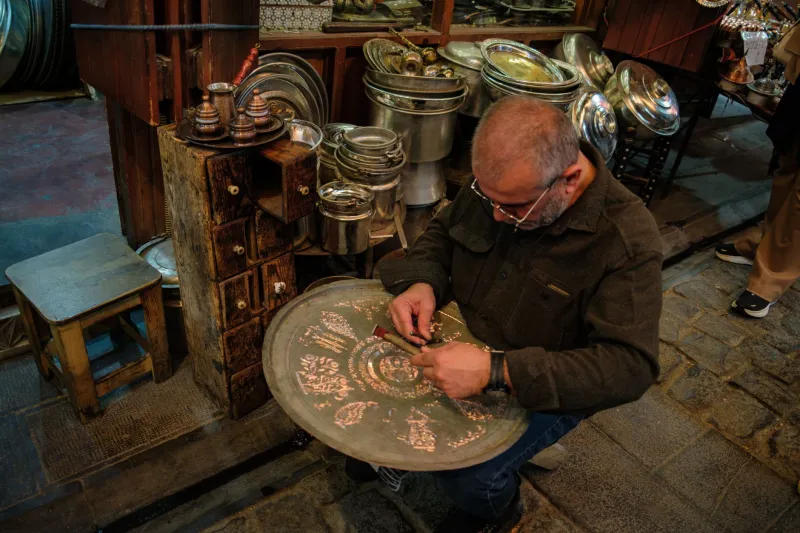
There is a reason this history lives in Istanbul rather than in a textbook. The city's commercial districts still carry the imprint of guild organization. In the workshops around the Grand Bazaar and the han buildings of Sirkeci, master-apprentice relationships persist in ways that have largely vanished from American commerce. Watching a coppersmith train a çırak over months of supervised repetition is a living demonstration of what deliberate, patient skill formation actually looks like.
For American professionals studying in Istanbul — whether through structured programs at institutions like Istanbul Akademisi or through immersive professional residencies — the guild legacy is not merely historical color. It is a case study in how training systems succeed when they are built on mastery rather than throughput.
The Takeaway for American Employers
Credentialism, as critics have noted for years, is expensive and ineffective: companies pay for signals that do not predict performance. The Ottoman guilds, whatever their faults, never confused the sign with the skill.
US organizations rebuilding their L&D functions would do well to ask a simple question before funding the next training initiative: at the end of this program, what will participants be able to demonstrate that they could not demonstrate before? If the answer is only a certificate, the six-hundred-year-old system along the Bosphorus already showed a better way.