Thinking in Strata: What Istanbul's Layered Civilizations Reveal About Solving Problems That Defy Simple Answers
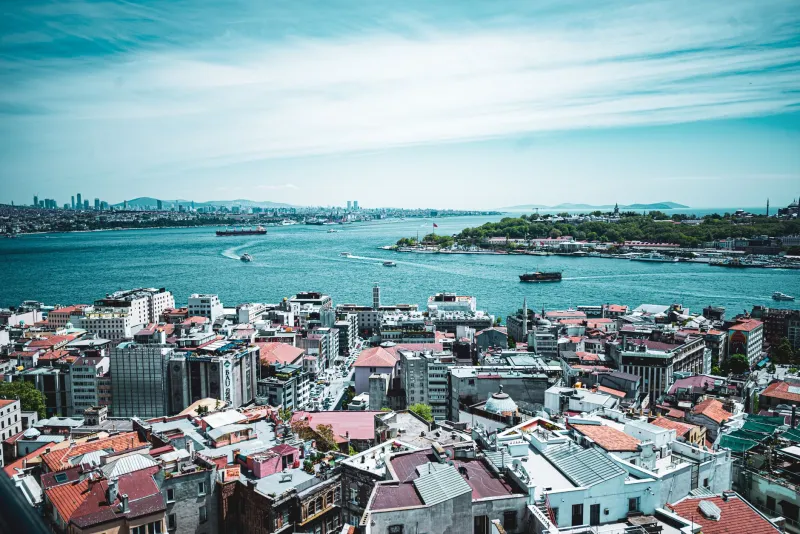
There is a moment that nearly every American professional experiences during their first week in Istanbul. Standing somewhere between the Byzantine walls of the old city and the glass towers of the financial district, they realize that what they are looking at cannot be processed in sequence. History is not behind them. It is beneath their feet, beside them, and actively shaping the conversation happening in the café across the street. Everything exists at once.
For most of us trained in Western business culture, that feeling is disorienting. We were educated to move from problem to solution in the most efficient path possible. Identify the variable. Isolate the cause. Apply the fix. It is a model that works beautifully in controlled environments. The modern global economy, however, is rarely a controlled environment.
Istanbul does not teach you to think faster. It teaches you to think deeper.
Why Linear Thinking Has a Ceiling
American business education has long celebrated decisiveness. MBA programs reward students who can cut through ambiguity and arrive at a clear answer. Consulting firms hire for the ability to simplify complexity into a three-point framework. These are genuinely valuable skills, and no serious professional should abandon them.
But there is a growing category of business challenge that resists this approach entirely. Supply chain disruptions that are simultaneously logistical, geopolitical, and cultural. Talent retention crises that are economic, psychological, and generational at the same time. Product launches that fail not because the strategy was wrong, but because three different stakeholder realities were never reconciled with one another.
These are not problems with a single root cause. They are problems with strata — layered systems in which each level influences every other level simultaneously. Solving them requires a fundamentally different cognitive posture, one that Istanbul has been quietly modeling for thousands of years.
A City That Has Never Been Just One Thing
Istanbul's identity is inseparable from its complexity. It has served as the capital of the Roman Empire, the Byzantine Empire, and the Ottoman Empire. It sits on two continents. Its architecture contains mosques built on the foundations of churches built on the foundations of temples. Its population speaks Turkish while absorbing Arabic, Greek, Kurdish, and now the languages of a global diaspora. Its economy bridges European financial markets and Asian manufacturing networks.
None of these layers erased the ones beneath. They accumulated. And the city that resulted from that accumulation does not function according to any single cultural logic. It functions according to the interplay of all of them.
For professionals who study here — whether through immersive in-person programs, structured residencies, or extended coursework at institutions like Istanbul Akademisi — exposure to this environment gradually recalibrates how the mind categorizes information. You stop looking for the single explanation. You start asking which explanations are operating in parallel.
The Cognitive Shift That Changes Everything
Psychologists and organizational theorists have a name for the mental model Istanbul demands: systems thinking. But what makes the Istanbul experience distinctive is that systems thinking is not delivered here as a concept. It is delivered as an environment.
When you spend weeks navigating a city where a traffic delay might be caused by a religious procession, a film shoot, a neighborhood market, and a municipal infrastructure project all converging on the same street at the same time, you stop expecting single causes. You develop what might be called layered situational awareness — the habit of scanning across multiple explanatory dimensions before committing to an interpretation.
Transferred to a boardroom or a project team, that habit is transformative. The professional who has internalized layered thinking does not arrive at a quarterly review asking only what the numbers say. They arrive asking what the numbers say, what the team dynamic suggests, what the competitive landscape implies, and what the cultural undercurrents of the client relationship might be revealing. They hold multiple frames simultaneously without collapsing into paralysis.
This is not a personality trait. It is a trained cognitive skill. And Istanbul, more than almost any other city on earth, is structured to develop it.
What This Looks Like in Practice
Consider the challenge facing many American companies attempting international expansion. The standard playbook — market research, localization, phased rollout — frequently underperforms in regions where business relationships are governed by trust networks, historical memory, and cultural protocols that no spreadsheet captures.
Professionals who have studied in Istanbul tend to approach these situations differently. They have learned, through direct experience, that a business conversation in a context like Istanbul is never only a business conversation. It is simultaneously a social negotiation, a display of relational respect, and an implicit test of long-term commitment. Understanding the deal requires understanding all three layers at once.
The same multi-dimensional awareness applies domestically. American workplaces are increasingly diverse, generationally complex, and politically sensitive. Leaders who can only read situations through a single lens — whether that lens is financial, procedural, or interpersonal — consistently miss critical signals. Those who have trained their perception to operate across multiple registers simultaneously are simply better equipped for the environments most companies now inhabit.
The Bosphorus as a Mental Model
There is something instructive about the strait that divides and connects Istanbul's two halves. The Bosphorus is not a boundary. It is a zone of simultaneous exchange — a place where currents from the Black Sea and the Sea of Marmara move in opposite directions at the same time, at different depths, without canceling each other out.
That image is a useful metaphor for the kind of thinking Istanbul cultivates. Not the elimination of contradiction, but the capacity to hold opposing currents in mind and navigate between them productively. Not the search for the one right answer, but the discipline to work with several partially right answers at once.
In an economy defined by volatility, interdependence, and rapid systemic disruption, that capacity is not a soft skill. It is a strategic advantage.
Building the Skill Deliberately
The good news for American professionals is that this kind of thinking can be developed intentionally. It does not require permanently relocating to Turkey or abandoning the analytical frameworks that already serve you well. It requires deliberate exposure to environments that resist simplification — and a structured learning context that helps you extract transferable insight from that exposure.
Programs designed around Istanbul's unique intellectual geography offer exactly that combination. The city provides the complexity. The curriculum provides the framework. The result is a professional who returns home not just with new knowledge, but with a fundamentally expanded range of cognitive tools.
The problems waiting for you in your next role will not all yield to straight lines. Some of them will require you to think in strata. Istanbul is one of the few places on earth that can teach you how.