Depth Over Speed: Why American Professionals Are Trading Hustle Culture for Istanbul's Sustainable Approach to Growth
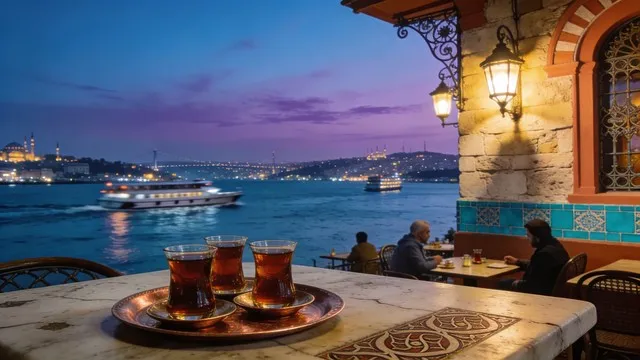
Photo: calm professional studying with tea overlooking Istanbul waterfront, via images.stockcake.com
For much of the past decade, American professional culture has operated under a particular set of assumptions: that productivity is best measured in hours logged, that the fastest path to mastery is the most compressed one, and that discomfort — the kind produced by relentless overextension — is simply the price of ambition. Silicon Valley gave this philosophy its most polished articulation, but its influence spread far beyond the tech sector, reshaping expectations in finance, consulting, healthcare administration, and beyond.
The results, by now, are well-documented. The American Psychological Association's annual Stress in America surveys have consistently identified work as a primary stressor for US adults, and the term "burnout" has migrated from clinical psychology into everyday professional vocabulary. Something, a growing number of professionals are concluding, has gone fundamentally wrong with the model.
What is less well-documented — but increasingly visible in the career decisions of thoughtful American professionals — is what the alternative actually looks like in practice. Istanbul Akademisi has become, perhaps unexpectedly, one of the clearest answers to that question.
The Problem with Speed
Hustle culture's central promise is that speed produces mastery. Compress the learning curve, maximize the inputs, and the outputs — skills, credentials, promotions — will follow. The appeal is understandable, particularly in a competitive professional environment where falling behind feels genuinely costly.
But cognitive science tells a different story. Research on skill acquisition consistently demonstrates that deep learning — the kind that produces durable competence and genuine adaptability — requires time for consolidation, reflection, and contextual application. The brain encodes knowledge most effectively not under conditions of relentless pressure but during periods of alternating engagement and rest. Cramming, whether for an exam or a professional certification, produces knowledge that is retrievable in the short term and forgotten in the medium term.
Hustle culture, in other words, is often optimized for the appearance of learning rather than its substance. It produces professionals who are credentialed but brittle — capable of performing competence in familiar contexts but poorly equipped to transfer skills to novel situations.
What Istanbul Does Differently
Istanbul Akademisi's approach to professional development is built on a different set of assumptions. The institution's programs are designed around the conviction that genuine skill development is a slow, cumulative, and deeply contextual process — one that benefits from immersion rather than acceleration.
This philosophy manifests in several concrete ways. Course structures allow for extended engagement with material rather than rapid progression through topic lists. Assessment frameworks emphasize demonstrated application over timed examination performance. And critically, the learning environment itself — the city of Istanbul — is treated as an active pedagogical resource rather than a backdrop.
This last point deserves elaboration. Istanbul is a city that rewards patience and punishes impatience. Navigating its layered history, its complex social codes, and its genuinely hybrid cultural identity requires a willingness to sit with ambiguity, to observe before acting, and to revise one's assumptions repeatedly. For American professionals accustomed to optimizing every interaction for efficiency, this is initially disorienting. Over time, it becomes transformative.
From FOMO to Intentionality
The cultural shorthand of FOMO — the fear of missing out — captures something real about the psychological texture of hustle culture. When professional development is framed as a race, every moment not spent advancing feels like a moment falling behind. The result is a chronic state of anxious acceleration that precludes the reflective practice genuine growth requires.
Istanbul's professional learning environment offers a structural interruption to this pattern. The city operates on its own rhythms — the call to prayer marking the hours, the unhurried ritual of çay over a business conversation, the deliberate pace of evening walks along the Bosphorus. These rhythms are not inefficiencies to be optimized away. They are, for many American professionals, the first genuine invitation in years to be fully present in an experience rather than racing through it.
This shift from anxious acquisition to intentional engagement is not merely a lifestyle preference. It has measurable professional consequences. Professionals who complete Istanbul Akademisi programs consistently report not only improved technical skills but enhanced capacity for strategic thinking, cross-cultural communication, and creative problem-solving — precisely the higher-order competencies that compressed, high-pressure learning environments struggle to develop.
Sustainability as a Professional Strategy
The concept of sustainable professional development is sometimes dismissed as a euphemism for reduced ambition. This misreads what sustainability actually means in a professional context. A sustainable approach to growth is not a slower approach to the same destination — it is a fundamentally different model of what professional excellence looks like and how it is achieved.
The most effective professionals are not those who burn brightest in their twenties and flame out before forty. They are those who maintain the intellectual curiosity, physical energy, and relational engagement to keep developing across a career that may span four or five decades. Istanbul Akademisi's programs are explicitly designed with this long-arc model in mind. The skills developed there — including the metacognitive skills of knowing how to learn, how to rest, and how to maintain professional relationships across cultural distance — are precisely those that compound over time.
For American professionals who have internalized hustle culture's assumptions without fully examining them, Istanbul offers something genuinely rare: a high-quality, internationally respected learning environment that treats depth, balance, and sustainable growth not as compromises but as the actual point.
A Different Kind of Ambition
Choosing Istanbul Akademisi is, in the end, an act of professional ambition — just a different kind than Silicon Valley tends to celebrate. It is the ambition to build a career that is genuinely excellent rather than merely exhausting, to develop skills that endure rather than credentials that expire, and to construct a professional identity capacious enough to grow across a lifetime.
The Bosphorus has been a site of exchange, learning, and reinvention for millennia. For American professionals ready to trade speed for depth, it remains one of the most compelling classrooms in the world.