Two Continents, One Classroom: How Istanbul's Geographic Identity Is Rewiring How American Business Leaders Think
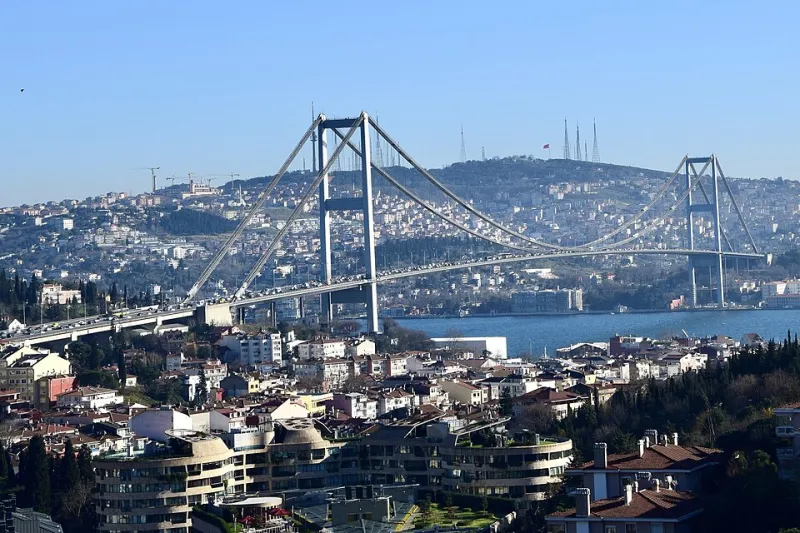
Photo: Ank Kumar, CC BY-SA 4.0, via Wikimedia Commons
There is a moment, familiar to many American professionals who have spent time studying or working in Istanbul, when the city's duality becomes impossible to ignore. Standing on the Galata Bridge at dusk, you can look west toward the European skyline of Beyoğlu and east toward the Asian district of Kadıköy — two distinct cultural worlds separated by nothing more than a stretch of moving water. For business leaders willing to pay attention, that view is more than scenic. It is instructive.
Istanbul's geographic position — straddling two continents, serving for centuries as a commercial and diplomatic crossroads — has produced a professional culture unlike any other in the world. Organizations here negotiate differently. Teams communicate across layers of hierarchy and tradition that would surprise even seasoned American executives. And for those who take the time to study this environment seriously, the rewards extend far beyond personal enrichment.
The Limits of the Western Business Playbook
Most American professionals enter the workforce having absorbed a fairly consistent set of assumptions about how business works: directness is valued, efficiency is paramount, and individual performance drives advancement. These principles are not wrong, but they are incomplete — and in an increasingly interconnected global economy, their limitations are becoming more costly.
Consider the experience of Marcus T., a senior operations director from Chicago who enrolled in a cross-cultural leadership program at Istanbul Akademisi. He arrived confident in his ability to manage diverse teams, having led departments across three US time zones. What he encountered in Istanbul challenged that confidence in productive ways.
"I walked into a negotiation simulation on my second week and completely misread the room," Marcus recalled. "My Turkish counterparts were being indirect in ways I interpreted as evasiveness. It took my instructor pulling me aside to explain that what I was seeing was actually a highly structured form of relationship-building — one that my counterpart expected me to recognize and reciprocate."
This gap between competence and cultural fluency is precisely what Istanbul's business environment exposes. And it is why a growing number of American companies are actively encouraging their high-potential leaders to seek training in environments where Western defaults simply do not apply.
Negotiation at the Crossroads
One of the most frequently cited lessons American professionals take away from Istanbul concerns negotiation style. Turkish business culture places considerable emphasis on personal trust, long-term relationship investment, and the reading of implicit signals — elements that can feel foreign to professionals trained in the more transactional, contract-first approach common in US business contexts.
At Istanbul Akademisi, structured programs in cross-cultural negotiation draw on the city's living context rather than abstract case studies. Students observe and participate in real commercial environments, working alongside local business professionals and engaging with visiting executives from across the Middle East, Central Asia, and Eastern Europe — regions that increasingly represent growth markets for American firms.
Jennifer L., a business development manager from New York who completed a four-week intensive program, described the practical impact on her career: "Within six months of returning home, I was leading a partnership discussion with a regional distributor in the Gulf. My team was frustrated because the deal was moving slowly. I recognized the pattern immediately — they were testing our commitment to the relationship, not stalling on the terms. We closed the deal three weeks later because I knew to slow down."
That kind of pattern recognition — the ability to read a room through a non-Western lens — is not something that can be taught from a textbook. It requires immersion, and Istanbul provides an unmatched context for developing it.
Organizational Culture as a Field Study
Beyond negotiation, Istanbul offers American professionals a rare window into alternative models of organizational culture. Many Turkish companies operate within layered hierarchies shaped by both modern corporate practices and deeply embedded cultural values around seniority, hospitality, and collective responsibility. Understanding these structures — not just tolerating them — equips professionals to manage international teams with greater nuance.
Programs at Istanbul Akademisi that focus on organizational behavior incorporate site visits to Istanbul-based multinationals, structured interviews with local managers, and facilitated reflection sessions that help American participants identify their own cultural assumptions. The goal is not to replace one set of values with another, but to expand the range of tools a leader carries.
Dr. Ayşe Kaya, a faculty member specializing in international management at Istanbul Akademisi, frames it this way: "Our American students often arrive believing they are culturally aware because they have managed diverse teams at home. What Istanbul teaches them is that diversity within a US context is still, in many ways, a variation on a single cultural theme. Here, the underlying assumptions themselves are different."
Bringing It Home: The Competitive Dividend
The professionals who benefit most from Istanbul's cross-cultural environment are not those who simply visit — they are those who study deliberately, reflect systematically, and return with a concrete framework for applying what they have learned.
Several American companies have begun to recognize this. Mid-sized firms in sectors ranging from logistics to financial services have started incorporating Istanbul-based training residencies into their leadership development pipelines, viewing the investment as a cost-effective alternative to more expensive executive programs at domestic business schools.
The competitive advantage is not hypothetical. Professionals who have studied in Istanbul consistently report improved performance in international client relationships, greater comfort with ambiguity in cross-border negotiations, and a measurably broader perspective when assessing global market entry strategies.
For Istanbul Akademisi, this represents a core part of its educational mission: not simply to teach business skills, but to use the city itself as a curriculum. Where knowledge meets the Bosphorus, the lessons run deeper than any single classroom can contain.
A Learning Environment That Cannot Be Replicated
No simulation, no case study, and no domestic diversity training program can replicate what a week of genuine immersion in Istanbul's business culture delivers. The city's layered history — as capital of empires, as a commercial hub linking continents, as a modern metropolis navigating the tensions between tradition and innovation — creates a learning environment of extraordinary density.
For American business leaders who are serious about developing a genuinely global perspective, Istanbul is not simply an interesting destination. It is, increasingly, an essential one.